Have Additional Questions? Contact Us: info(at)aviadiag.com

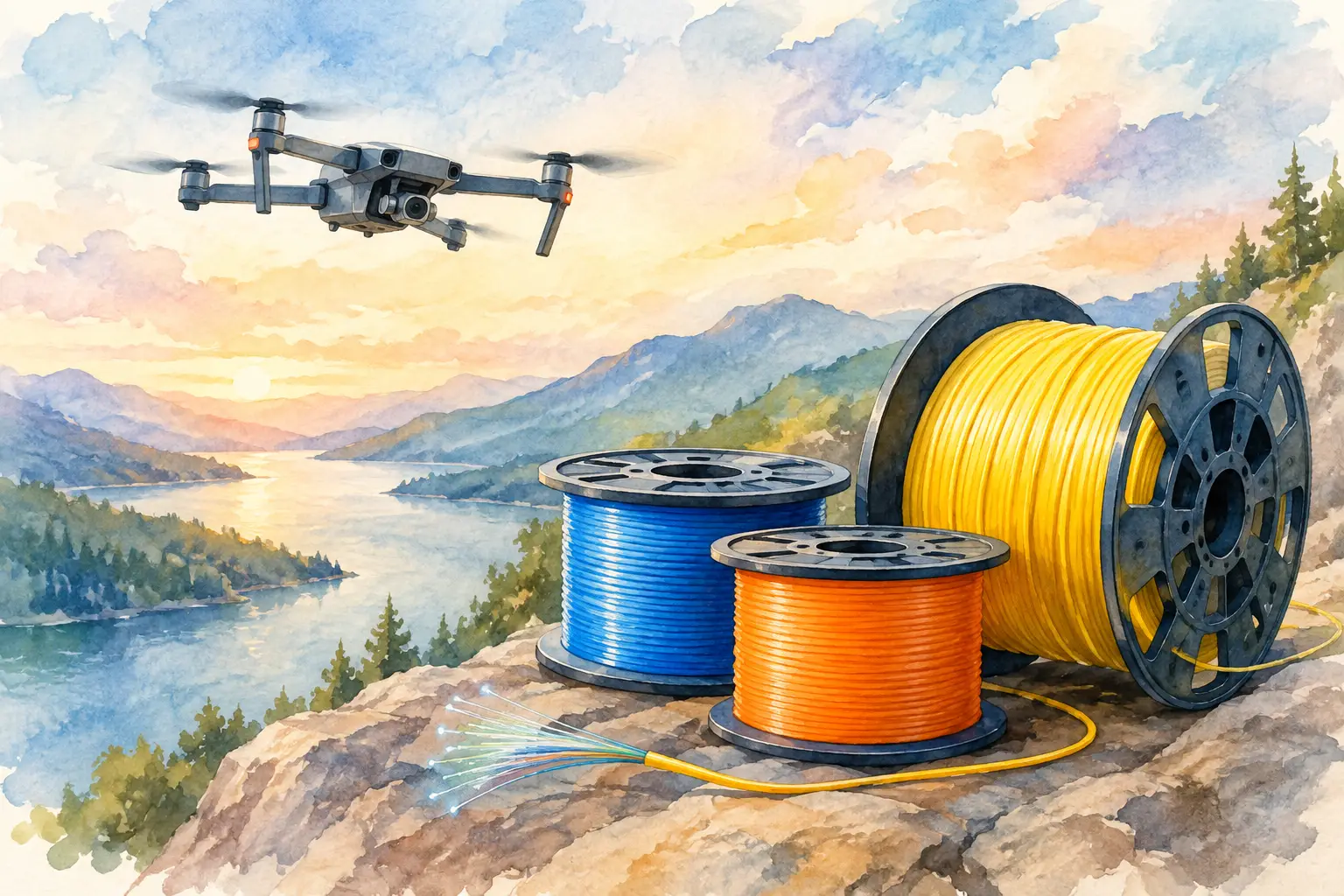
A fibre optic spool for drones is not a minor accessory choice. Once it is fitted to an FPV airframe, its weight, payout behaviour and optical compatibility can affect balance, handling and the reliability of the complete link. The right disc supports a defined operating objective; the wrong one can add drag, disturb the centre of gravity or introduce connection problems that only appear after launch.
For builders working beyond standard radio configurations, optical fibre creates a distinct design challenge. You are selecting a physical payload and a signal-path component at the same time. That means looking beyond fibre length alone and matching the spool to the aircraft, optical hardware and intended flight profile.
What a Fibre Optic Spool for Drones Changes
Optical fibre does not behave like a conventional antenna system. A fibre-based setup relies on an unbroken optical path between compatible equipment, so the spool, connectors and fibre specification must be treated as one system. The disc needs to release fibre consistently while the aircraft remains within its practical payload and power limits.
The trade-off is straightforward: more fibre generally gives a larger operating envelope, but it also means more mass and bulk. A longer disc may be the right choice for a larger platform with suitable lift capacity. On a compact FPV build, that same choice can reduce acceleration, shorten usable flight time and make the aircraft less predictable during rapid changes in direction.
Spool placement matters just as much. A disc mounted away from the aircraft’s centre of gravity can create a noticeable handling penalty, particularly as the remaining spool mass changes during use. Builders should plan the mounting position early, rather than treating the fibre unit as an item to add after the frame, battery and video system are already fixed.
Start With the Mission Envelope
The correct configuration begins with the flight requirement. Consider the airframe’s all-up weight, available thrust, battery capacity, intended duration and the type of manoeuvring expected. A stable, larger platform can usually carry a more substantial fibre assembly than a fast, lightweight FPV craft built for agility.
Fibre length is only useful when the airframe can carry it
It is easy to prioritise maximum length, but excess capacity is not automatically a performance upgrade. If the spool turns a responsive aircraft into an underpowered one, the wider theoretical range may not produce a better real-world result. Choose a length that fits the operational distance you genuinely need, with an appropriate margin rather than an arbitrary maximum.
The route and recovery plan also matter. Fibre is a physical connection, not an invisible radio path. Operators need to account for the environment, flight path, mounting arrangement and the possibility of snagging or excessive tension. Use only in lawful, controlled applications and within the aviation, land-access and privacy requirements that apply to the operating location.
Weight distribution can matter more than headline weight
Two spools with similar overall mass may affect a build very differently. Diameter, width and mounting position change how the assembly sits on the frame. A compact disc mounted close to the centreline may preserve handling better than a larger unit with the same stated weight positioned far from the centre of gravity.
Check clearance around propellers, camera tilt mechanisms, battery straps and the flight controller stack. The spool should not interfere with cooling, maintenance access or the ability to secure the aircraft safely for transport. If the build requires a dedicated bracket, include the bracket, fasteners and strain-relief hardware in the weight calculation from the start.
Match the Fibre Disc to the Optical System
Fibre components are not universally interchangeable. Connector type, fibre type, termination quality and the requirements of the optical transmitter and receiver all need to align. A spool that appears physically suitable can still be the wrong component if it does not match the rest of the signal chain.
Confirm whether the system specifies single-mode or multimode fibre, the required connector format and the supported optical performance characteristics. Do not force or adapt connectors without confirming that the complete arrangement is designed to work together. An optical link can be sensitive to contamination, poor mating surfaces and unnecessary joins.
Before committing a disc to a build, inspect the manufacturer specifications for fibre length, spool dimensions, net weight and compatible equipment. For specialised FPV configurations, direct component support is often more valuable than choosing on price alone. Aviadiag can help builders identify suitable optical fibre discs when the build calls for a nonstandard component match.
Mechanical Payout Is a Performance Requirement
A fibre disc must release smoothly enough for the aircraft’s expected movement. Poor payout can introduce tension, inconsistent drag or fibre damage. This is why spool construction, winding quality and enclosure design deserve as much attention as the optical specification.
Look at how the disc will be retained during transport and operation. The housing should protect the fibre from crushing, abrasion and contamination without preventing controlled release. A loosely secured spool can shift under vibration; an over-constrained spool can resist payout. Neither condition belongs on a performance-focused aircraft.
Bend radius is another practical limit. Fibre should not be routed around tight corners or pinched beneath straps, plates or cable ties. Keep the route clean, protect it from sharp edges and use strain relief where the fibre meets the aircraft-mounted hardware. These simple installation choices can prevent faults that otherwise look like intermittent video or link failures.
Build Validation Before Field Use
A fibre-equipped aircraft should be checked as a complete assembly, not as separate parts that passed bench tests. Start with the airframe powered down. Confirm that the spool is secure, the fibre route is clear and no moving component can contact the disc or line. Then verify that connectors are clean, properly seated and protected from strain.
With the system powered, check the optical equipment according to its intended operating procedure and confirm stable video or data performance before any flight activity. A short, controlled ground check can reveal poor connector seating, cable pinch points, spool rubbing or unexpected vibration. If the aircraft’s balance has changed, revisit flight-controller setup and confirm the platform remains appropriate for the revised take-off weight.
Use a repeatable pre-flight inspection. A practical check should cover the spool mount, fibre condition, connector cleanliness, propeller clearance, battery security and flight-control response. These are not administrative details. They are the checks that protect the component investment and help keep a specialised FPV build predictable.
Choose for the Build You Are Actually Flying
The best fibre optic spool is the one that supports the aircraft’s defined performance target without forcing compromises elsewhere in the build. A compact disc may be the smarter choice for an agile platform. A larger-capacity spool may fit a heavier airframe designed around endurance and stable carriage. Neither is universally better.
Treat the fibre disc as part of the aircraft architecture from the first component list. When length, mass, mechanical payout and optical compatibility are selected together, the result is a cleaner build with fewer surprises at the point that matters most: when your aircraft needs to perform exactly as configured.